

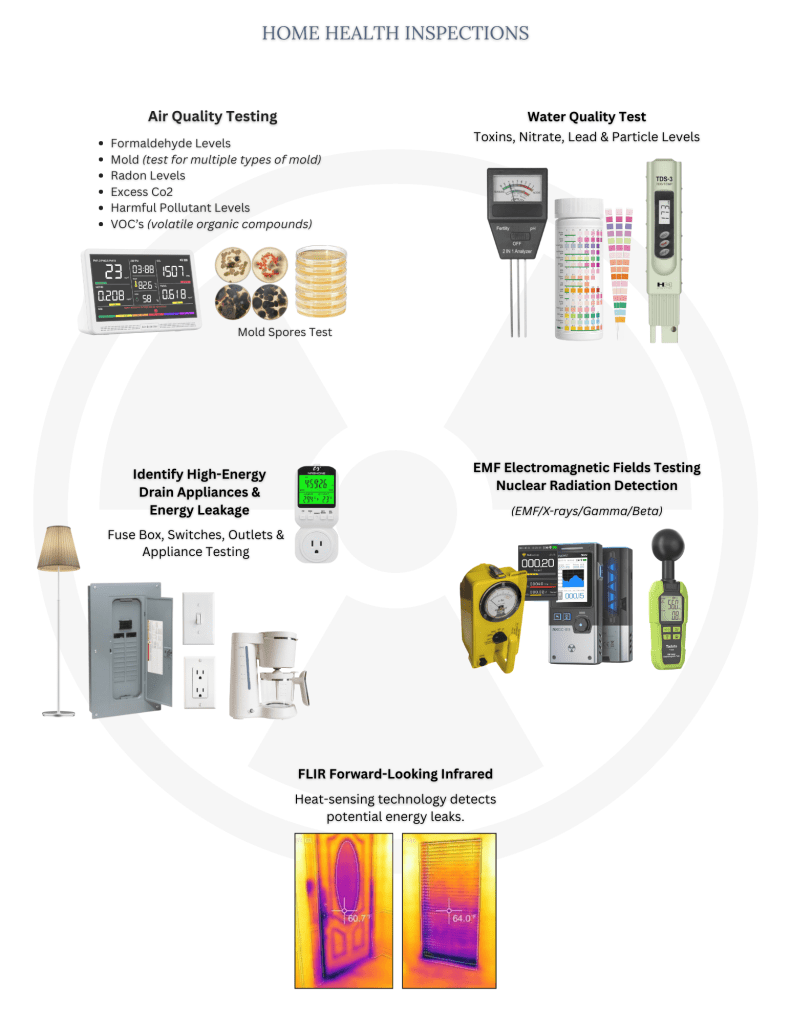
Our home inspection services are designed to give you peace of mind by helping you understand the safety, comfort, and efficiency of your home. We take a thorough approach to identify potential concerns and provide clear answers, so you can feel confident in the place you live. Each inspection includes:
- Locating areas of excess EMF exposure, including appliances that give off higher-than-normal energy or radiation levels.
- Testing your water for safety and quality, including particulates, nitrates, pH balance, lead, radon in water, and microscopic analysis for parasites, bacteria, or other hidden contaminants.
- Checking for local radiation levels, including x-ray, gamma, and beta sources that may be present in building materials or older items.
- Assessing indoor air quality, by measuring formaldehyde, CO₂ buildup, VOCs, mold, airborne particles, and radon gas.
- Measuring light quality, including blue light levels from LEDs, screens, and fixtures that can affect sleep, eye health, and comfort.
- Detecting combustible gases, including natural gas and propane leaks, as well as ensuring carbon monoxide levels are safe with specialized monitoring.
- Using advanced thermal imaging (FLIR), to locate hidden energy loss around windows, doors, walls, ceilings, and floors, as well as identifying potential moisture inside walls or under flooring.
Every room in your home is inspected carefully and individually, since conditions can vary from one space to another. This room-by-room approach ensures that nothing is overlooked, helps catch issues that might otherwise go unnoticed, and prevents small problems from turning into large, costly hazards.
With every Home Health Inspection, you’ll receive a full comprehensive report designed to give you a clear, detailed view of your home’s condition. This professional report is over 40 pages long and includes photos, diagrams, and test results where appropriate, so you can see exactly what we found during the inspection.
During your Home Health Inspection, the inspector is available to answer any questions or concerns you may have. If a potential issue is identified, the inspector will provide on-site recommendations and explain possible remedies to help you understand the best next steps. The goal is to give you clarity, peace of mind, and practical solutions for creating a healthier home.
The report doesn’t just list problems — it provides clear, practical steps you can take to remedy any issues that may have been identified. From reducing radon and EMF exposure, to improving air quality, to addressing mold, water quality, or gas safety, you’ll have a roadmap for making your home healthier, safer, and more efficient.
Your inspection report also includes the results of air sampling for mold in each room, as well as a drinking water analysis, so you’ll know exactly what’s in the air you breathe and the water you drink.
The goal is simple: to give you complete peace of mind and actionable solutions for creating a safer, healthier home for you and your family. Your safety and comfort are our top priority — we provide more than a checklist, we provide confidence.
“Inspections can feel intimidating, but most issues we find are simple and inexpensive to fix. The goal isn’t to ‘fail’ your house—it’s to help you create a healthier, safer space. Small changes like better ventilation or sealing moisture can greatly reduce allergies, asthma triggers, and other risks. Think of it as uncovering opportunities to make your home the healthiest it can be.”
Click-Here: Why Families with Children & Pets Need a Home Health Inspection

Your home should be the safest place on earth for your loved ones. But many modern houses quietly harbor hidden threats — invisible, odorless, and often impossible to detect without specialized equipment. These hazards settle in the air you breathe, the water you drink, the walls that surround you, and even the light that fills your rooms.
For households with young children and pets, the risks are even higher. Many of these dangers concentrate near the ground — exactly where kids crawl, toddlers play, and animals rest. A Home Health Inspection exposes these invisible risks, giving you clear answers and peace of mind.
Expanded Dangers We Detect (and Why They Matter)
- Radon Gas – A Silent Cancer Risk
Radon is a colorless, odorless radioactive gas that seeps through cracks in foundations. Long-term exposure is the second leading cause of lung cancer in the U.S. after smoking. Children and pets, who breathe more rapidly and spend time close to floors, are especially vulnerable . - Formaldehyde & VOCs – Toxic Indoor Pollutants
Household materials, flooring, furniture, and paints can release harmful gases like formaldehyde and volatile organic compounds (VOCs). These irritants cause eye, nose, and throat issues, and long-term exposure has been linked to cancer and organ damage . - Mold & Hidden Moisture – A Growing Threat
Mold thrives in damp or humid spaces, often hidden behind walls or under flooring. It can cause musty odors, trigger asthma, worsen allergies, and damage building materials. Our FLIR thermal imaging and non-invasive moisture meters catch mold before it spreads . - Radiation & EMF – Invisible Energy Hazards
Everyday items like antique clocks, smoke detectors, Wi-Fi routers, and even certain building materials may emit radiation or electromagnetic fields (EMFs). High or prolonged exposure can increase health risks, disrupt sleep, and reduce overall well-being . - Contaminated Water – Risks Hiding in Every Glass
Clear-looking water can still contain parasites, coliform bacteria, nitrates, lead, fluoride, or radon. These contaminants may cause developmental problems in children, digestive illnesses, or long-term damage to organs. Our microscopic analysis ensures your family’s drinking water is safe . - Carbon Monoxide & Combustible Gases – Deadly Yet Undetectable
Carbon monoxide is known as the “silent killer” because it is odorless and colorless. Even small leaks can cause headaches, dizziness, or worse — and pets or children are usually the first to show symptoms. We also check for propane and natural gas leaks, which pose both poisoning and fire risks . - Blue Light Exposure – A Hidden Strain on Health
Modern LEDs, screens, and fixtures release high levels of blue light. Overexposure disrupts sleep cycles, strains eyes, and reduces comfort. By measuring your home’s light quality, we ensure it supports, rather than harms, your family’s health .
Why Our Inspection Stands Apart:
Unlike standard home inspections that focus only on structure and surface-level issues, our approach digs deeper into environmental health, energy efficiency, and hidden risks. Every room is inspected individually, ensuring nothing is overlooked. This prevents small problems from turning into large, costly hazards and gives you the most accurate picture of your home’s overall safety.
With years of specialized training and advanced equipment, we deliver a clear, detailed 40-page report within 4–5 days, complete with notes, photos, and actionable solutions.
The result? Confidence, peace of mind, and the ability to protect your investment and your family for years to come .
The complete Home Health Inspection results will be emailed to you 4–5 days after the inspection. This timeframe allows us to:
- Conduct a bacterial water test and provide results
- Confirm any potential mold spores have germinated enough to be identified
- Analyze your drinking water under a microscope for possible parasites
📋Included Tests: – Click a Topic Below to Learn More
Radon: The Invisible Threat in Your Home
Radon is a silent danger that every homeowner should take seriously. It’s a colorless, odorless, radioactive gas that comes from the natural breakdown of uranium in soil and rock. You can’t see it, smell it, or taste it — but it can seep into your home through cracks in the foundation, gaps around pipes, or even your basement floor. Once inside, it can build up to unsafe levels without you ever realizing it.
Here’s why that matters: radon is the second leading cause of lung cancer in the U.S., right behind smoking. Long-term exposure puts you and your family at serious risk, and because symptoms don’t appear until years later, many people don’t discover the danger until it’s too late.
Radon is heavier than air, which means it lingers close to the ground — right where children and pets spend the most time. Your dogs, cats, or other animals may be breathing in higher concentrations every day, putting their health at risk too.
If your home uses a private well, the danger can be even greater. Radon can dissolve in groundwater and enter your home through normal activities like showering, cooking, or doing laundry. That means you could be exposed two ways — by breathing it in the air and by ingesting it through your water.
The good news? Radon can be detected with simple testing, and effective solutions are available to reduce it. But since you can’t sense it on your own, testing is the only way to know if your home is safe.
Don’t wait until it’s too late — protect your family and your pets by testing for radon today.
Learn more about Radon Gas in the home: Click-Here
Formaldehyde: The Hidden Chemical in Your Home
Formaldehyde is a toxic gas that can lurk inside your home without you realizing it. Unlike radon, formaldehyde has a sharp, irritating odor — but just because you don’t smell it doesn’t mean it’s not there. It’s commonly released from building materials, pressed-wood products, new furniture, flooring, and even everyday items like cleaning supplies or fabrics. Freshly renovated or newly furnished homes often have the highest levels.
Breathing in formaldehyde can cause burning, watery eyes, sore throat, coughing, and skin irritation. At higher levels, it can trigger asthma attacks and make breathing difficult. Even worse, long-term exposure has been linked to certain cancers, making it more than just an annoyance — it’s a serious health hazard.
Because formaldehyde gas is heavier than air, it can settle lower to the ground. That means children and pets, who spend more time closer to the floor, may be at even greater risk of exposure.
The danger is that formaldehyde doesn’t just “go away.” It can continue to off-gas slowly for months or even years, depending on the source. Poor ventilation only makes the problem worse, allowing the chemical to build up in the air you breathe every day.
The good news is there are steps you can take: testing your home’s air quality, improving ventilation, and choosing low-emission materials and products. But just like radon, you won’t know if it’s a problem unless you test.
Learn more about Formaldehyde Gas: Click-Here
VOC’s: Everyday Chemicals Polluting Your Air
Volatile Organic Compounds — or VOC’s — are gases released from countless everyday household items. Paints, cleaning products, flooring, furniture, air fresheners, and even some cosmetics all release VOC’s into the air. The problem? When you’re indoors, these gases don’t just vanish — they build up, especially in tightly sealed homes, and you and your family end up breathing them in.
In the short term, VOC exposure can cause burning eyes, runny nose, scratchy throat, headaches, and dizziness. For people with asthma or allergies, the effects can be even worse. But the bigger danger lies in long-term exposure — studies have linked VOC’s to damage of the liver, kidneys, and nervous system, as well as an increased risk of certain cancers.
Since VOC’s are released at ground level, children and pets are often the most exposed, spending more time where concentrations can be strongest.
And here’s the kicker: VOC’s can linger for weeks, months, or even years after a renovation, new furniture purchase, or fresh coat of paint. That “new home smell” or “new furniture smell”? It’s often VOC’s — and it’s not as harmless as it seems.
The good news: you can take control by testing indoor air quality, improving ventilation, and choosing low-VOC or VOC-free products whenever possible. But you won’t know your exposure levels unless you check.
Learn more about VOC’s found in the home: Click-Here
Radiation: The Hidden Sources Inside Your Home
When most people hear “radiation,” they think of nuclear plants or X-rays — but radiation can be present in your home every day without you realizing it. The most common source is radon gas, a radioactive gas that seeps in from the soil. But radiation can also come from certain building materials (like some types of stone, granite, or concrete) and even older household items such as antique clocks, luminous watches, or early-model smoke detectors that used radioactive paint or components.
While trace amounts are normal, elevated or long-term exposure is a serious health risk. Radon exposure, in particular, is the second leading cause of lung cancer in the U.S. — right behind smoking. Because radiation damage happens slowly and without obvious warning signs, many people don’t realize the danger until health issues appear years later.
Radiation tends to concentrate in lower areas of the home, meaning children and pets who spend more time close to the floor could be at greater risk of exposure.
The unsettling truth is that you can’t see, smell, or feel radiation. The only way to know if your home has elevated levels is through proper testing. If found, there are proven ways to reduce exposure and protect your household.
Learn more about home Radiation in the home: Click-Here
Mold: The Silent Invader in Your Home
Mold isn’t just an eyesore — it’s a living fungus that can spread quickly anywhere moisture lingers. It thrives in damp or humid areas such as basements, bathrooms, crawl spaces, or around leaky pipes, often showing up as black, green, or white patches on walls, ceilings, or furniture. Along with staining surfaces and producing a strong, musty odor, mold can also damage building materials over time, eating away at wood, drywall, and insulation.
The health risks are just as serious. Mold spores float in the air and can cause allergy symptoms, asthma flare-ups, persistent coughing, and respiratory irritation. For children, the elderly, pets, or anyone with weakened immune systems, the effects can be even more severe.
Since mold spreads by releasing microscopic spores, the contamination doesn’t stay confined to the spot you can see. What looks like a small patch on the wall could actually mean hidden colonies inside walls, under floors, or in ventilation systems — silently affecting your home’s air quality every time you breathe.
The danger is that mold doesn’t go away on its own. Without proper cleanup and moisture control, it will keep returning and spreading.
Protect your family, your pets, and your home’s structure — act quickly if you see or suspect mold, and always address the moisture problem that feeds it.
Learn more about Mold (Fungus) in the home: Click-Here
Carbon Dioxide: The Silent Sign of Poor Air in Your Home
Carbon dioxide (CO₂) is a natural gas we exhale with every breath, but when it builds up indoors, it can become a hidden health concern. In tightly sealed or poorly ventilated homes, CO₂ levels can rise quickly — especially in bedrooms at night, basements, or crowded living spaces. You won’t smell it or see it, but elevated CO₂ is a clear indicator that your indoor air is stale, trapped, and not being refreshed.
High levels of CO₂ can cause headaches, fatigue, poor concentration, and dizziness. Over time, it may even affect sleep quality, mood, and overall health. Children and pets, who often spend more time indoors and closer to the floor where heavy gases collect, can feel the effects the most.
Unlike some pollutants, CO₂ itself isn’t toxic at normal household levels — but it acts as a warning sign. If CO₂ is high, that means other pollutants (like VOCs, formaldehyde, or radon) could also be trapped inside and building up.
The good news: CO₂ levels are easy to measure, and improving ventilation — by using fans, opening windows, or upgrading HVAC systems — can quickly reduce the problem. But without testing, you won’t know if the air you and your family are breathing every day is fresh and safe.
Learn more about Carbon Dioxide in the home: Click-Here
Carbon Monoxide: The Silent Killer in Your Home
Carbon monoxide (CO) is a colorless, odorless, and tasteless gas created when fuels like natural gas, propane, wood, coal, or oil burn incompletely. Without a detector, there’s no way to know it’s present — which is why it’s often called the “silent killer.”
When inhaled, CO replaces oxygen in your bloodstream, starving your body of the air it needs to survive. Early symptoms — headaches, dizziness, nausea, or confusion — are easy to mistake for the flu. Prolonged exposure can quickly lead to loss of consciousness, permanent brain damage, or death.
Common household sources of CO include furnaces, fireplaces, water heaters, stoves, and vehicles running in attached garages. Even well-maintained appliances can leak carbon monoxide if ventilation is blocked or damaged.
The only reliable protection is a carbon monoxide detector, properly installed and maintained on every level of the home. These devices continuously monitor the air and alert you at the first sign of danger — giving you and your family time to get to safety.
Learn more about Carbon Monoxide in the home: Click-Here
Lead: A Hidden Danger That Never Goes Away
Lead is a toxic metal that was once commonly used in household paint, plumbing, and even older fixtures. While its use has been banned in new products for decades, it still lingers in many older homes — and exposure can be extremely dangerous, especially for children and pets.
The most common sources of lead in the home are:
- Paint: Homes built before 1978 often contain lead-based paint. When that paint chips, peels, or creates dust, it can be inhaled or ingested. Even small amounts can harm developing brains and nervous systems.
- Water: Older plumbing systems may contain lead pipes or lead solder. Over time, lead can leach into drinking water, meaning every glass of water, shower, or pet bowl could be a source of contamination.
Health risks from lead are severe. In children, lead exposure can cause developmental delays, learning problems, behavioral issues, and nervous system damage. In adults, it can contribute to high blood pressure, kidney damage, and reproductive issues. And because lead doesn’t break down in the body, the effects can build up over time.
Learn more about Lead in paint & water: Click-Here
Water Quality: The Hidden Risks in Your Tap
Clean water is something most families take for granted — but what looks clear in a glass can still hide serious health risks. Three of the biggest concerns in household water are nitrates, pH imbalance, and high particle levels.
- Nitrates: These come from fertilizers, septic systems, and agricultural runoff. They can seep into groundwater and contaminate private wells. High nitrate levels are especially dangerous for infants and young children, leading to a potentially life-threatening condition called “blue baby syndrome” by reducing the blood’s ability to carry oxygen. Long-term exposure in adults has been linked to certain cancers and other health concerns.
- pH Imbalance: Water that’s too acidic (low pH) can corrode pipes, leaching toxic metals like lead and copper into your drinking water. Water that’s too alkaline (high pH) may taste bitter and leave buildup on faucets and appliances. Both extremes can affect plumbing, appliances, and your family’s health over time.
- Particle Levels (Turbidity): Even if your water looks clear, it may contain tiny suspended particles like sand, silt, rust, or organic matter. High particle levels don’t just make water look cloudy — they can also carry harmful bacteria, chemicals, or heavy metals, and they may cause irritation to skin or stomach if consumed.
Testing is the only way to know what’s in your water. Lab-certified water tests measure nitrates, pH balance, and particle levels accurately. If problems are found, solutions range from filtration and water softening systems to reverse osmosis treatment or addressing plumbing issues directly.
Learn more about your water: Click-Here
Excess EMF: Household Radiation Build-up You Can’t See
Excess EMF, or electromagnetic fields, are invisible energy waves produced by everyday electrical devices, appliances, and wiring in your home. From Wi-Fi routers and cell phones to microwaves, smart meters, and even poorly grounded wiring, these sources can create a constant build-up of household radiation exposure.
While EMFs are invisible and silent, studies suggest that long-term, high exposure may affect sleep, increase stress, and contribute to headaches, fatigue, or difficulty concentrating. Some research has also raised concerns about potential links between chronic EMF exposure and more serious health issues, although risks vary depending on intensity and duration.
Because EMFs are strongest closest to the source, children and pets — who often spend more time on the floor or near plugged-in devices — may experience higher exposure levels.
The challenge with EMFs is that you can’t detect them without specialized equipment. Testing is the only way to know if your home has areas of excess EMF build-up. Once identified, solutions may include rearranging how devices are used, improving electrical grounding, or shielding problem areas to reduce exposure.
Learn more about EMF Pollution in your home: Click-Here
High-EMF & Radiation-Heavy Appliances: Everyday Devices, Hidden Exposure
Some household appliances and electronics give off much higher levels of electromagnetic fields (EMFs) than others. These high-EMF, radiation-heavy appliances can create “hotspots” of invisible energy in your home, exposing you to elevated levels of household radiation whenever they’re in use — or even just plugged in.
Common culprits include microwaves, refrigerators, induction cooktops, Wi-Fi routers, cordless phones, baby monitors, and smart devices. Even some older or poorly wired appliances can leak excess EMF into your living spaces, creating hidden risks.
While EMFs are invisible and silent, studies suggest that long-term, high exposure may interfere with sleep, increase stress, and contribute to headaches, fatigue, or difficulty concentrating. Some research has also raised concerns about potential links to more serious health problems when exposure is constant and close.
The challenge is that you won’t know where these radiation “hotspots” are without proper testing. Specialized EMF testing can identify which appliances in your home are producing harmful levels and help you take action — whether that means rearranging furniture, adjusting usage habits, upgrading wiring, or replacing older equipment.
Learn more about EMF-Heavy Devices: Click-Here
Thermal Imaging: Finding Hidden Heat Loss & Moisture Before It Becomes a Problem
Your home may look solid and secure, but behind the walls, under floors, and around doors and windows, there could be hidden issues draining energy or creating the perfect environment for damage. Using advanced FLIR thermal imaging technology, we can see what the eye can’t — spotting heat loss, air leaks, and potential moisture problems inside your home.
With this tool, we check windows, doors, walls, ceilings, and floors for areas where conditioned air is escaping or outside air is creeping in. These weak spots don’t just raise your energy bills — they make your home less comfortable year-round.
Even more importantly, thermal imaging helps reveal moisture buildup inside walls or under flooring before it shows visible signs like stains, warping, or mold. Left unchecked, hidden leaks or damp areas can lead to structural damage, mold growth, and costly repairs.
Because these problems often stay invisible until they’re serious, thermal imaging provides homeowners with peace of mind and early detection. By finding issues now, you can fix them before they spread — saving money and protecting your home’s long-term health.
Thermal imaging is your home’s X-ray — showing where energy is lost and where moisture may be hiding.
Learn more about FLIR & Heat Loss in the home: Click-Here
Blue Light Exposure: The Hidden Strain in Your Home
Not all light is the same. Modern homes filled with LED bulbs, screens, and electronic devices often produce high levels of blue light — a short-wavelength light that can affect both comfort and health. Using a specialized light meter, we measure the spectrum of light in your rooms to detect excess blue light and evaluate how it may be impacting your living environment.
Excessive blue light, especially in the evening, can disrupt natural sleep cycles by suppressing melatonin production. Over time, this can lead to poor sleep quality, fatigue, irritability, and difficulty concentrating. Blue light exposure has also been linked to eye strain, headaches, and potential long-term risks to eye health.
Since blue light is invisible to the eye beyond just its brightness, you won’t know how much you’re being exposed to without testing. Our inspections identify where blue light levels may be too high — whether from overhead lighting, LED bulbs, computer screens, or mobile devices — so you can make informed changes, such as adjusting lighting, upgrading bulbs, or using filters.
Your home’s lighting should keep you comfortable — not put your health at risk. Blue light testing ensures your living spaces support healthy rest, clear vision, and everyday well-being.
Learn more about Blue-Light in the home: Click-Here
Natural Gas & Combustible Gas Leaks: Invisible, Explosive, and Deadly
Natural gas and propane power many homes — fueling stoves, water heaters, furnaces, and fireplaces. While convenient, these gases come with a serious risk: leaks are invisible, highly flammable, and can turn deadly in seconds.
Even a small leak can allow gas to build up indoors, creating an explosion hazard if it meets a spark or flame. Beyond fire risk, breathing in concentrated natural gas can cause headaches, dizziness, nausea, and in severe cases, suffocation.
Using a specialized gas detection device with concentration display, we can check for leaks from appliances, piping, and connections. This tool not only detects the presence of natural gas, propane, or other combustible gases — it also pinpoints the source of the leak so it can be fixed quickly and safely.
Because gas is odorless in its natural state, utility companies add a “rotten egg” smell for detection — but relying on your nose isn’t always enough. A detector provides early warning and precise measurement to ensure your home is safe.
Learn more about combustible gases in the home: Click-Here
Microscopic Water Testing: Seeing the Hidden Threats in Your Drinking Water
Even clear, fresh-looking water can hide dangers too small for the eye to see. By collecting water samples and examining them under a microscope, we can detect parasites and other microscopic contaminants that pose risks to your family’s health.
Parasites such as Giardia and Cryptosporidium are among the most concerning — they can survive standard disinfection and cause severe stomach illness, diarrhea, and dehydration. But parasites aren’t the only hidden threat. Under the microscope, we may also detect:
- Bacteria colonies (such as E. coli) that indicate contamination from sewage or animal waste.
- Algae or mold spores that suggest organic buildup in plumbing or water storage.
- Sediment and mineral crystals that point to corrosion or scaling in pipes.
- Microplastics or other particulates from environmental pollution.
While chemical testing reveals what’s dissolved in your water, microscopic analysis shows what’s living or floating in it — the things most likely to make you sick.
If contaminants are found, solutions may include filtration systems, UV treatment, or addressing the source of pollution. Either way, knowing what’s in your water gives you the power to protect your household.
Don’t trust clear water alone — microscopic testing ensures your water is truly safe to drink.
Learn more about Microscopic Water Testing: Click-Here
Coliform Bacteria in Water
Clean water is essential for every household — but even crystal-clear water can carry invisible threats. One of the most important indicators of water safety is the presence of coliform bacteria.
What Are Coliform Bacteria?
Coliform bacteria are a group of microorganisms naturally found in soil, plants, and the intestines of humans and animals. While most types are not dangerous on their own, they are considered a warning sign. If coliforms are present in your water, it means there may be a pathway for more harmful bacteria — like E. coli, viruses, or parasites — to enter your drinking supply.
Why It Matters:
Drinking water contaminated with harmful bacteria can cause serious health issues, including diarrhea, stomach cramps, nausea, and fever. Infants, young children, the elderly, and people with weakened immune systems are especially at risk. Even pets and livestock can become sick from contaminated water, which can spread illness within a household or farm.
How Coliforms Get Into Water:
- Cracks or defects in a well casing
- Contamination from septic systems or agricultural runoff
- Flooding or surface water entering a well
- Poor plumbing or backflow issues inside the home
Testing and Solutions:
The only way to know if coliform bacteria are present is through a certified water test. If coliforms are detected, follow-up testing can determine if harmful strains like E. coli are also present. Solutions may include disinfecting the well, repairing plumbing, improving drainage, or installing appropriate filtration systems.
Learn more about Coliform Bacteria: Click-Here
Non-Invasive Moisture Meter Scanning
Moisture is one of the most common — and most overlooked — threats to a home. Even when walls, ceilings, or floors look perfectly fine on the surface, hidden moisture can weaken structures, attract pests, and lead to costly repairs. That’s why inspectors often use a non-invasive moisture meter scanner to detect hidden water problems without damaging building materials.
How It Works:
A non-invasive scanner uses electronic signals to measure moisture levels below the surface of materials like drywall, cement board, softwood, and hardwood. Unlike invasive probes that puncture surfaces, this method is quick, clean, and leaves no marks — making it ideal for inspecting finished areas of a home.
Why It Matters:
Undetected moisture can cause:
- Mold and mildew growth that affects air quality and can trigger allergies or respiratory issues
- Structural damage, including warping, rotting, or weakened framing
- Damage to finishes, such as bubbling paint, cracked drywall, or stained ceilings
- Pest infestations, since many insects and rodents are drawn to damp environments
Common Sources of Moisture Problems:
- Roof leaks or poor flashing
- Plumbing leaks inside walls or under floors
- Improperly sealed windows or doors
- Foundation cracks or basement seepage
- High indoor humidity or poor ventilation
Testing and Prevention:
A non-invasive moisture scan helps identify potential problem areas early, often before visible damage appears. If high moisture levels are detected, further investigation may be needed to confirm the source and extent of the problem. Corrective actions may include repairing leaks, improving ventilation, sealing foundations, or installing dehumidification systems.
Learn more about Non-Invasive Moisture Meter Scanning: Click-Here
Electrical Outlet Testing: Protecting Your Home from Hidden Wiring Hazards
Everyday outlets may look fine on the outside, but hidden wiring problems can put your home at serious risk. Using an advanced outlet tester with LCD display and GFCI check, we inspect your standard 3-prong electrical outlets to ensure they are properly wired, grounded, and safe.
This tool helps identify dangerous conditions such as:
- Reversed polarity wiring (hot and neutral wires swapped) that can damage appliances or create shock hazards.
- Open grounds or open neutrals that leave your outlets unprotected against surges or faults.
- Faulty GFCI outlets that may fail to trip when needed, increasing the risk of electrical shock near kitchens, bathrooms, and outdoor areas.
Even small wiring issues can increase the chance of electric shock, appliance damage, or even electrical fires. By testing every outlet, we ensure your electrical system is not only functional but also meets modern safety standards.
Electrical safety starts at the outlet — our testing gives you peace of mind that your home’s wiring is safe, grounded, and protecting your family.
Learn more about Electrical Outlet Testing: Click-Here
EXAMPLE Silent Hazards Inspection Report
 Home Health Inspections